How to Teach Your Child the Arabic Alphabet at Home: A Step-by-Step Guide for Parents
A practical guide for parents who want to help their children learn the Arabic alphabet, build confidence with Arabic letters, and prepare for Quran reading.
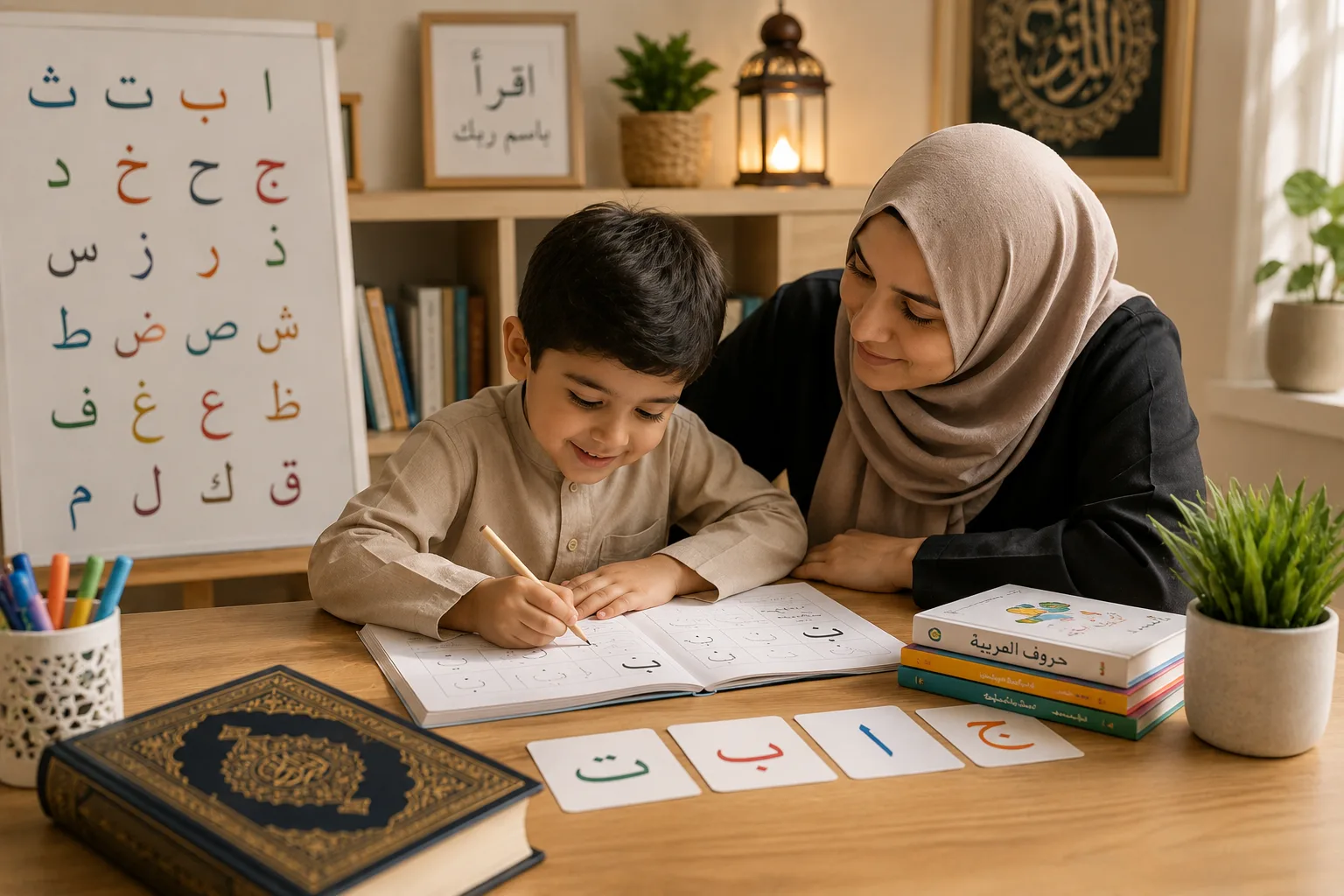
Every journey with the Quran begins with a single letter.
Before a child can read words, recite verses, or learn Tajweed correctly, they must first become familiar with the Arabic alphabet. For many parents, this raises an important question:
How can I teach my child the Arabic alphabet at home if I am not an Arabic teacher?
The good news is that you do not need advanced Arabic knowledge to give your child a strong foundation. What matters most is consistency, encouragement, and creating positive experiences around learning.
At Alphabets of Islam, we regularly work with children who have already been introduced to Arabic letters at home. Those early experiences often make the transition into formal Arabic and Quran lessons smoother, more enjoyable, and more successful.
Why Teach the Arabic Alphabet at Home?
Children learn best through repeated exposure. When Arabic becomes part of everyday life — even for a few minutes each day — it begins to feel familiar rather than foreign. This familiarity can significantly increase a child’s confidence when they begin structured Arabic or Quran lessons.
Teaching Arabic letters at home also creates opportunities for meaningful parent-child interaction and helps children associate Islamic learning with positive memories.
At this stage, success means recognising Arabic letters, becoming comfortable seeing them, hearing their sounds regularly, and developing curiosity about the Quran and Arabic language. Correct pronunciation and advanced reading skills can develop gradually with guidance from qualified teachers.
Explore Arabic Foundations for children
Your goal is not perfection. Familiarity and positive association are everything at this stage. A child who enjoys their first experiences with Arabic letters is far more likely to thrive when formal lessons begin.
When Should Children Start Learning the Arabic Alphabet?
Most children are ready to begin recognising Arabic letters between the ages of 4 and 5. Some children start earlier, while others may need more time.
Rather than focusing only on age, consider whether your child can sit and focus for 10–15 minutes, follow simple instructions, enjoy learning activities, and show curiosity about books, language, or the Quran. If you are wondering whether your child is ready to begin Quran classes, those same readiness signs apply here.
Step 1: Start With Arabic Letters, Not Words
One of the most common mistakes parents make is rushing into reading words before children have mastered individual letters. The Arabic alphabet contains 28 letters, each with its own shape and sound. Before reading begins, children should be able to recognise each letter visually, identify its name, and associate it with its sound.
This foundation makes every later stage easier. Children who skip letter recognition often struggle when they begin reading — and correcting that later takes far more time than building it properly from the start.
Effective Ways to Teach Arabic Letters
Arabic Alphabet Charts — Place a chart somewhere your child sees every day: bedroom walls, study areas, dining spaces, or playrooms. Frequent visual exposure helps children absorb letters naturally.
Flashcards — Introduce 3–4 letters per week with short daily reviews and fun recognition games. Keep sessions brief and enjoyable.
Arabic Alphabet Songs — Children often remember songs faster than spoken repetition. Arabic alphabet songs and nasheeds can reinforce letter recognition while keeping learning playful.
Tracing Activities — Children who trace Arabic letters repeatedly remember them more quickly because they are engaging both visual and motor memory. Workbooks, whiteboards, and reusable tracing sheets all work well.
Step 2: Build a Simple Daily Arabic Routine
Consistency is more important than intensity. Ten minutes every day is usually more effective than one long session each week.
A simple daily routine that works: 2 minutes reviewing known letters → 3 minutes introducing one new letter → 3 minutes tracing or writing → 2 minutes celebrating progress. That is it. Ten minutes.
Keep the tone light and encouraging throughout. Praise effort rather than perfection. Children who feel successful are more likely to stay motivated.
Step 3: Connect Arabic Letters to the Quran
One of the most powerful things parents can do is connect Arabic learning to the Quran from the beginning. Even before children can read, they can understand that these letters have a special purpose.
Explain that these are the letters of the Quran — the letters used in Allah’s words — and that learning them helps us read the Quran. Let children listen to Quran recitation, show them a Mushaf respectfully, and encourage curiosity and questions.
These small moments often leave lasting impressions. A child who grows up seeing the Quran as something beautiful and meaningful — not just something to study — will approach lessons with a completely different energy.
Step 4: Use Games and Play-Based Learning
Young children learn through play. Turning Arabic learning into a game often produces better results than formal instruction alone.
Letter Hunt — Hide Arabic flashcards around the room and ask children to find specific letters.
Matching Games — Match letters to letters, letters to sounds, or letters to images.
Magnetic Arabic Letters — Use a magnetic board or refrigerator surface for interactive learning.
Letter of the Day — Choose one Arabic letter and focus on it throughout the day, searching for it on charts, books, and flashcards.
Step 5: Know When to Bring in a Teacher
Parents provide the foundation. Teachers help build upon it.
Once children know most Arabic letters and can recognise them consistently, they are often ready for structured Arabic or Quran lessons. A qualified teacher can help children learn correct pronunciation, letter connections, short vowels, reading fluency, Quran recitation skills, and basic Tajweed foundations.
Early guidance from a qualified teacher often prevents incorrect habits from developing — and incorrect pronunciation habits in Arabic can be very difficult to correct later.
At Alphabets of Islam, our Arabic Foundations program is designed specifically for children who have some letter familiarity and are ready to take the next step. Our teachers are experienced in guiding young learners from letters to fluent Quran reading.
Common Mistakes Parents Should Avoid
Rushing into reading words — Strong letter recognition should come first. Children who skip this stage often struggle later.
Inconsistency — Young children learn through repetition. Several days without practice can slow progress significantly.
Excessive correction — Too much correction can reduce confidence. Focus on encouragement and gradual improvement.
Ignoring proper pronunciation — Some Arabic sounds do not exist in English or other languages. Children benefit from hearing accurate pronunciation from qualified teachers and authentic Arabic sources.
Making learning feel like a test — Pressure often reduces motivation. Keep sessions positive, interactive, and enjoyable.
Frequently Asked Questions
How long does it take a child to learn the Arabic alphabet?
Most children can recognise the Arabic alphabet within a few months when practising consistently. Progress varies depending on age, readiness, and frequency of exposure.
What is the best age to start learning Arabic letters?
Many children begin successfully between ages 4 and 6, although readiness matters more than age alone.
Can I teach my child the Arabic alphabet if I don’t speak Arabic?
Yes. Parents can successfully introduce Arabic letters through charts, flashcards, songs, and guided activities, even without fluency in Arabic.
Should my child learn Arabic before Quran classes?
Learning Arabic letters before Quran lessons often gives children a stronger foundation and greater confidence when reading begins.
What are the best activities for teaching Arabic letters to children?
Flashcards, tracing activities, Arabic alphabet charts, songs, and games like letter hunts are all effective. Short, consistent daily sessions work better than occasional long ones.
Ready for the Next Step?
Once your child becomes comfortable with the Arabic alphabet, structured learning can help them progress further with confidence. Our Arabic Foundations and online Quran classes for children are designed to help children build strong reading skills step by step, with qualified teachers and flexible online lessons.