Category: Uncategorized

  • How to Teach Your Child the Arabic Alphabet at Home

    For Parents

    How to Teach Your Child the Arabic Alphabet at Home: A Step-by-Step Guide for Parents

    A practical guide for parents who want to help their children learn the Arabic alphabet, build confidence with Arabic letters, and prepare for Quran reading.
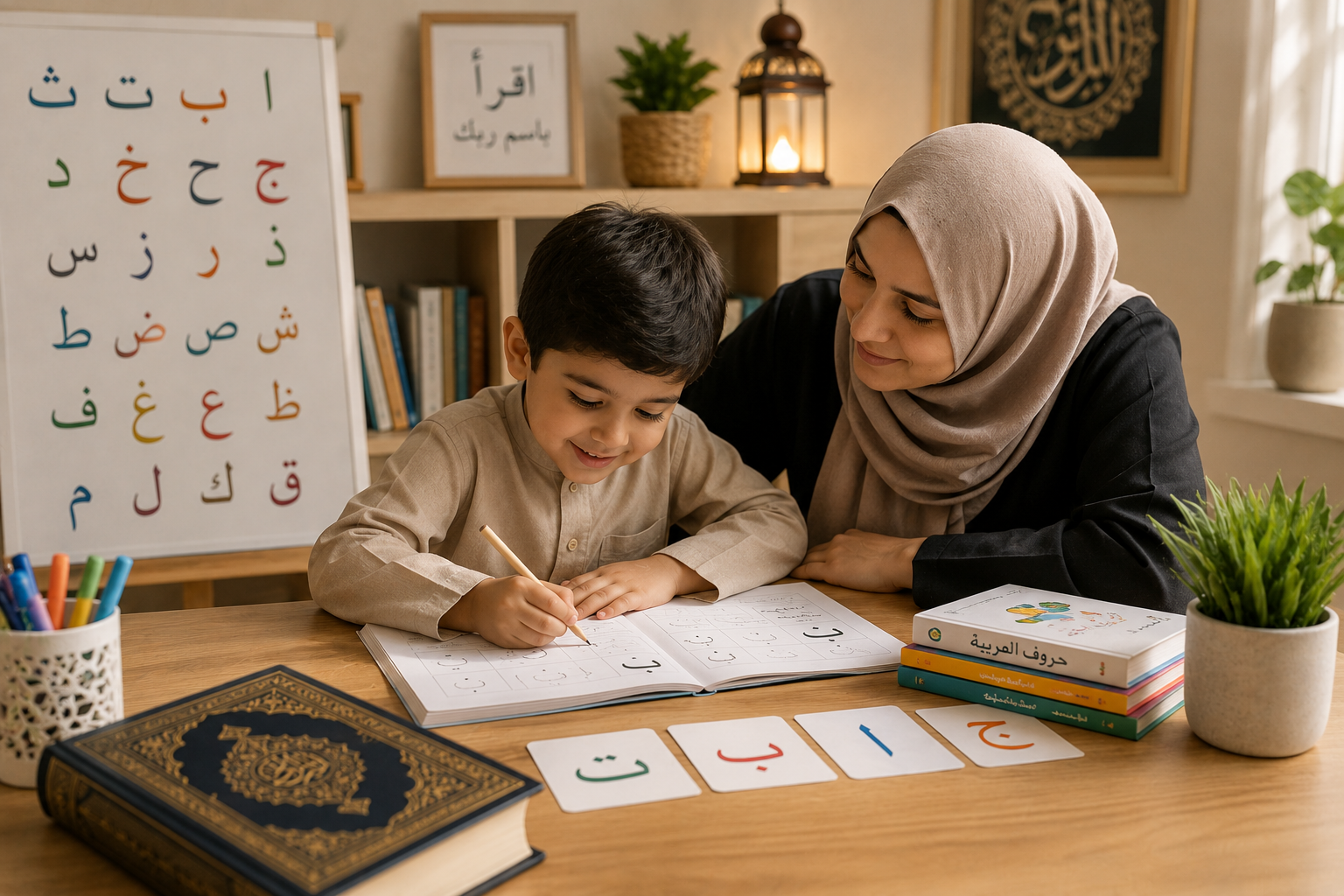
    Child learning Arabic alphabet at home with parent support before Quran lessons

    Every journey with the Quran begins with a single letter.

    Before a child can read words, recite verses, or learn Tajweed correctly, they must first become familiar with the Arabic alphabet. For many parents, this raises an important question:

    How can I teach my child the Arabic alphabet at home if I am not an Arabic teacher?

    The good news is that you do not need advanced Arabic knowledge to give your child a strong foundation. What matters most is consistency, encouragement, and creating positive experiences around learning.

    At Alphabets of Islam, we regularly work with children who have already been introduced to Arabic letters at home. Those early experiences often make the transition into formal Arabic and Quran lessons smoother, more enjoyable, and more successful.


    Why Teach the Arabic Alphabet at Home?

    Children learn best through repeated exposure. When Arabic becomes part of everyday life — even for a few minutes each day — it begins to feel familiar rather than foreign. This familiarity can significantly increase a child’s confidence when they begin structured Arabic or Quran lessons.

    Teaching Arabic letters at home also creates opportunities for meaningful parent-child interaction and helps children associate Islamic learning with positive memories.

    At this stage, success means recognising Arabic letters, becoming comfortable seeing them, hearing their sounds regularly, and developing curiosity about the Quran and Arabic language. Correct pronunciation and advanced reading skills can develop gradually with guidance from qualified teachers.

    Your goal is not perfection. Familiarity and positive association are everything at this stage. A child who enjoys their first experiences with Arabic letters is far more likely to thrive when formal lessons begin.


    When Should Children Start Learning the Arabic Alphabet?

    Most children are ready to begin recognising Arabic letters between the ages of 4 and 5. Some children start earlier, while others may need more time.

    Rather than focusing only on age, consider whether your child can sit and focus for 10–15 minutes, follow simple instructions, enjoy learning activities, and show curiosity about books, language, or the Quran. If you are wondering whether your child is ready to begin Quran classes, those same readiness signs apply here.


    Step 1: Start With Arabic Letters, Not Words

    One of the most common mistakes parents make is rushing into reading words before children have mastered individual letters. The Arabic alphabet contains 28 letters, each with its own shape and sound. Before reading begins, children should be able to recognise each letter visually, identify its name, and associate it with its sound.

    This foundation makes every later stage easier. Children who skip letter recognition often struggle when they begin reading — and correcting that later takes far more time than building it properly from the start.

    Effective Ways to Teach Arabic Letters

    Arabic Alphabet Charts — Place a chart somewhere your child sees every day: bedroom walls, study areas, dining spaces, or playrooms. Frequent visual exposure helps children absorb letters naturally.

    Flashcards — Introduce 3–4 letters per week with short daily reviews and fun recognition games. Keep sessions brief and enjoyable.

    Arabic Alphabet Songs — Children often remember songs faster than spoken repetition. Arabic alphabet songs and nasheeds can reinforce letter recognition while keeping learning playful.

    Tracing Activities — Children who trace Arabic letters repeatedly remember them more quickly because they are engaging both visual and motor memory. Workbooks, whiteboards, and reusable tracing sheets all work well.


    Step 2: Build a Simple Daily Arabic Routine

    Consistency is more important than intensity. Ten minutes every day is usually more effective than one long session each week.

    A simple daily routine that works: 2 minutes reviewing known letters → 3 minutes introducing one new letter → 3 minutes tracing or writing → 2 minutes celebrating progress. That is it. Ten minutes.

    Keep the tone light and encouraging throughout. Praise effort rather than perfection. Children who feel successful are more likely to stay motivated.


    Step 3: Connect Arabic Letters to the Quran

    One of the most powerful things parents can do is connect Arabic learning to the Quran from the beginning. Even before children can read, they can understand that these letters have a special purpose.

    Explain that these are the letters of the Quran — the letters used in Allah’s words — and that learning them helps us read the Quran. Let children listen to Quran recitation, show them a Mushaf respectfully, and encourage curiosity and questions.

    These small moments often leave lasting impressions. A child who grows up seeing the Quran as something beautiful and meaningful — not just something to study — will approach lessons with a completely different energy.


    Step 4: Use Games and Play-Based Learning

    Young children learn through play. Turning Arabic learning into a game often produces better results than formal instruction alone.

    Letter Hunt — Hide Arabic flashcards around the room and ask children to find specific letters.

    Matching Games — Match letters to letters, letters to sounds, or letters to images.

    Magnetic Arabic Letters — Use a magnetic board or refrigerator surface for interactive learning.

    Letter of the Day — Choose one Arabic letter and focus on it throughout the day, searching for it on charts, books, and flashcards.


    Step 5: Know When to Bring in a Teacher

    Parents provide the foundation. Teachers help build upon it.

    Once children know most Arabic letters and can recognise them consistently, they are often ready for structured Arabic or Quran lessons. A qualified teacher can help children learn correct pronunciation, letter connections, short vowels, reading fluency, Quran recitation skills, and basic Tajweed foundations.

    Early guidance from a qualified teacher often prevents incorrect habits from developing — and incorrect pronunciation habits in Arabic can be very difficult to correct later.

    At Alphabets of Islam, our Arabic Foundations program is designed specifically for children who have some letter familiarity and are ready to take the next step. Our teachers are experienced in guiding young learners from letters to fluent Quran reading.


    Common Mistakes Parents Should Avoid

    Rushing into reading words — Strong letter recognition should come first. Children who skip this stage often struggle later.

    Inconsistency — Young children learn through repetition. Several days without practice can slow progress significantly.

    Excessive correction — Too much correction can reduce confidence. Focus on encouragement and gradual improvement.

    Ignoring proper pronunciation — Some Arabic sounds do not exist in English or other languages. Children benefit from hearing accurate pronunciation from qualified teachers and authentic Arabic sources.

    Making learning feel like a test — Pressure often reduces motivation. Keep sessions positive, interactive, and enjoyable.


    Frequently Asked Questions

    How long does it take a child to learn the Arabic alphabet?

    Most children can recognise the Arabic alphabet within a few months when practising consistently. Progress varies depending on age, readiness, and frequency of exposure.

    What is the best age to start learning Arabic letters?

    Many children begin successfully between ages 4 and 6, although readiness matters more than age alone.

    Can I teach my child the Arabic alphabet if I don’t speak Arabic?

    Yes. Parents can successfully introduce Arabic letters through charts, flashcards, songs, and guided activities, even without fluency in Arabic.

    Should my child learn Arabic before Quran classes?

    Learning Arabic letters before Quran lessons often gives children a stronger foundation and greater confidence when reading begins.

    What are the best activities for teaching Arabic letters to children?

    Flashcards, tracing activities, Arabic alphabet charts, songs, and games like letter hunts are all effective. Short, consistent daily sessions work better than occasional long ones.


    Ready for the Next Step?

    Once your child becomes comfortable with the Arabic alphabet, structured learning can help them progress further with confidence. Our Arabic Foundations and online Quran classes for children are designed to help children build strong reading skills step by step, with qualified teachers and flexible online lessons.
  • What Is Tajweed in the Quran? Why Proper Recitation Matters

    What Is Tajweed in the Quran? Why Proper Recitation Matters

    Quran Learning

    What Is Tajweed in the Quran? Why Proper Recitation Matters

    A clear, honest guide for parents and adult learners — explaining what Tajweed actually is, why it matters, and how proper Quran recitation is preserved from generation to generation.

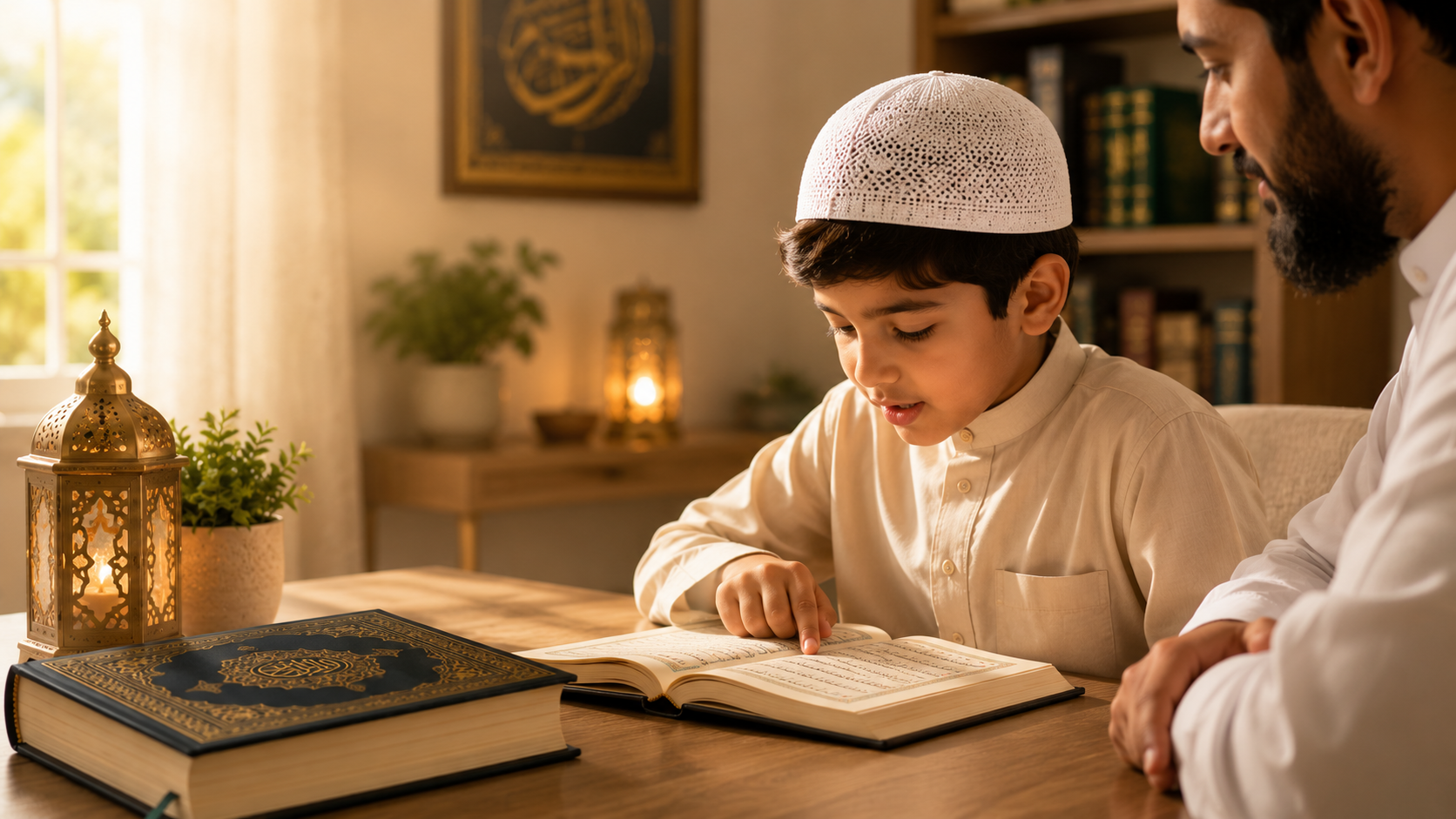
    Child and parent learning Tajweed and Quran recitation online with Alphabets of Islam

    If you have ever heard someone recite the Quran beautifully — with measured rhythm, precise pronunciation, and a natural flow — you were hearing Tajweed in action.

    But Tajweed is not simply about making the Quran sound beautiful.

    It is a science of Quran recitation that helps preserve the words of Allah exactly as they were revealed and transmitted. It protects pronunciation, preserves meaning, and teaches Muslims how to recite the Quran with care and respect.

    At Alphabets of Islam, we regularly work with children, teenagers, and adults who are learning Tajweed for the first time. One of the most common misconceptions we encounter is that Tajweed is only about improving the sound of recitation. In reality, it plays a much deeper role in preserving accurate Quran recitation.

    In this guide, we will explain what Tajweed is, why it matters, when students should begin learning it, and what to look for in a qualified Tajweed teacher.


    What Does “Tajweed” Actually Mean?

    The word Tajweed (تجويد) comes from an Arabic root meaning to improve, to make better, or to do something well.

    In the context of Quran recitation, Tajweed refers to the rules that govern how each letter of the Quran should be pronounced. These rules cover:

    • The correct articulation point of each letter (Makharij)
    • The characteristics of letters (Sifaat)
    • Elongation rules (Madd)
    • Nasal sounds (Ghunna)
    • Rules of stopping and starting (Waqf and Ibtida)
    • The interaction between letters when reciting

    The Prophet Muhammad ﷺ received the Quran in a specific manner of recitation, and that recitation has been transmitted from teacher to student through generations. Tajweed helps preserve that method of recitation.

    Allah says in the Quran: “And recite the Quran with measured recitation.” (Quran 73:4) — The word used is Tartil: slow, careful, and measured. Tajweed is how Muslims fulfil this command.


    Why Does Tajweed Matter?

    Tajweed matters for three important reasons.

    1. Correct Pronunciation

    Arabic contains sounds that do not exist in many other languages. Letters such as ع (Ayn), ح (Haa), غ (Ghayn), and ض (Dhad) must be pronounced from specific points in the throat, tongue, and mouth.

    When these sounds are pronounced incorrectly, the word may change completely. In some situations, a single incorrectly pronounced letter can alter the meaning of a verse. Tajweed serves as a safeguard against these mistakes.

    2. Preservation of Meaning

    The Quran is the exact word of Allah. Every letter, vowel, pause, and elongation carries significance. Tajweed rules were preserved to help ensure that recitation remains faithful to the original revelation.

    3. Respect and Reverence

    Reciting the Quran is an act of worship. Just as Muslims prepare themselves physically and spiritually before prayer, they should also strive to recite the Quran with care and respect. Learning Tajweed is part of giving the Quran the honour it deserves.

    A note from our teachers: We regularly work with students who have been reciting for years but developed small pronunciation habits that went uncorrected. The earlier Tajweed is introduced, the easier it is to build strong, lasting foundations.


    Reading the Quran vs Reading With Tajweed

    Many beginners can learn to recognise Arabic letters and read Quranic words accurately. Tajweed goes a step further — it teaches how each letter should sound, how long vowels extend, where to pause, and how sounds interact.

    Reading helps you recognise the words. Tajweed helps you recite them correctly.

    Students who learn Tajweed often develop stronger confidence, better pronunciation, and a deeper connection with Quran recitation.


    The Most Common Tajweed Rules Beginners Learn

    Tajweed contains many rules, but most students begin with a core group that appears frequently throughout the Quran.

    Noon Sakinah and Tanween

    These rules govern the pronunciation of the “n” sound when it appears without a vowel or at the end of a word. Students learn Izhar, Idgham, Iqlab, and Ikhfa.

    Meem Sakinah

    These rules apply to the letter Meem when it appears without a vowel and determine how it interacts with the letters that follow.

    Madd (Elongation)

    Madd rules determine how long certain sounds should be stretched — students learn when to extend sounds by 2, 4, or 6 counts.

    Qalqalah

    Qalqalah creates a slight echoing or bouncing sound on specific letters — ق ط ب ج د — when they occur in particular situations.

    Heavy and Light Letters

    Students learn when letters should be pronounced with heaviness (Tafkheem) and when they should be pronounced lightly (Tarqeeq). This is especially important for ر (Ra) and ل (Lam).

    Waqf (Stopping)

    Waqf teaches students where they may stop, where it is preferable to stop, and where stopping may affect meaning — preserving the message of the Quran.

    Important: Tajweed cannot be mastered from books alone. Students need to hear correct recitation, practise consistently, and receive correction from a qualified teacher. This is how the Quran has been transmitted for over 1,400 years.


    What Challenges Arise Without Tajweed Training?

    Many people learn to read Quranic Arabic without studying Tajweed. They may recognise the letters and move through the text, but common issues develop: heavy letters become light, elongations are shortened or omitted, pauses occur in unsuitable places, letters merge incorrectly, and the natural rhythm of recitation is lost.

    Perhaps the biggest challenge is that incorrect habits become very difficult to change later. For this reason, it is usually easier to learn correctly from the beginning.


    At What Age Should Tajweed Be Introduced?

    The foundations of correct pronunciation should begin from the first Quran lesson. Young children are often very capable of learning proper sounds naturally through repetition and listening.

    More detailed Tajweed rules are typically introduced once a child becomes comfortable reading the Quran and can maintain consistent focus. Many students begin formal Tajweed between the ages of 7 and 9, although readiness matters more than age. Adults can begin at any age.

    Readiness over age. We have seen 6-year-olds take to Tajweed naturally, and adults in their 50s master the rules with patience and consistency. The right teacher and the right structure make all the difference.


    What to Look for in a Tajweed Teacher

    Not everyone who recites beautifully is equipped to teach Tajweed effectively. A good Tajweed teacher should have recognised qualifications — ideally an Ijazah in Quran recitation — a corrective ear, a structured teaching method with gradual rule introduction, and the patience to support students through consistent correction.

    At Alphabets of Islam, all our Tajweed teachers hold recognised qualifications and are experienced in teaching both children and adults. Every lesson includes structured correction — because that is how real progress happens.


    Frequently Asked Questions

    Is Tajweed mandatory when reading the Quran?

    Muslims should strive to recite the Quran correctly according to their ability. Learning Tajweed helps preserve accurate pronunciation and reduces mistakes during recitation.

    Can I read the Quran without learning Tajweed?

    A person can read the Quran while learning, but studying Tajweed helps ensure that words are pronounced correctly and that meanings are preserved.

    How long does it take to learn Tajweed?

    Many students learn the fundamentals within a few months. Mastery develops over time through regular recitation, listening, and correction by qualified teachers.

    Should children learn Tajweed from the beginning?

    Children should learn correct pronunciation from their earliest Quran lessons. Detailed Tajweed rules can then be introduced gradually as they progress.


    Learn Tajweed the Right Way

    Whether you are helping your child begin Quran recitation or improving your own reading, strong Tajweed foundations make a lasting difference. Our qualified teachers guide students through every stage — with structured lessons, personalised correction, and consistent support.

  • When Should a Child Start Quran Classes? 5 Signs They Are Ready

    When Should a Child Start Quran Classes? 5 Signs They Are Ready

    For Parents

    When Should a Child Start Quran Classes? 5 Signs They Are Ready

    How to know when your child is truly ready to begin — and how to make their first experience of Quran learning positive, enjoyable, and lasting.

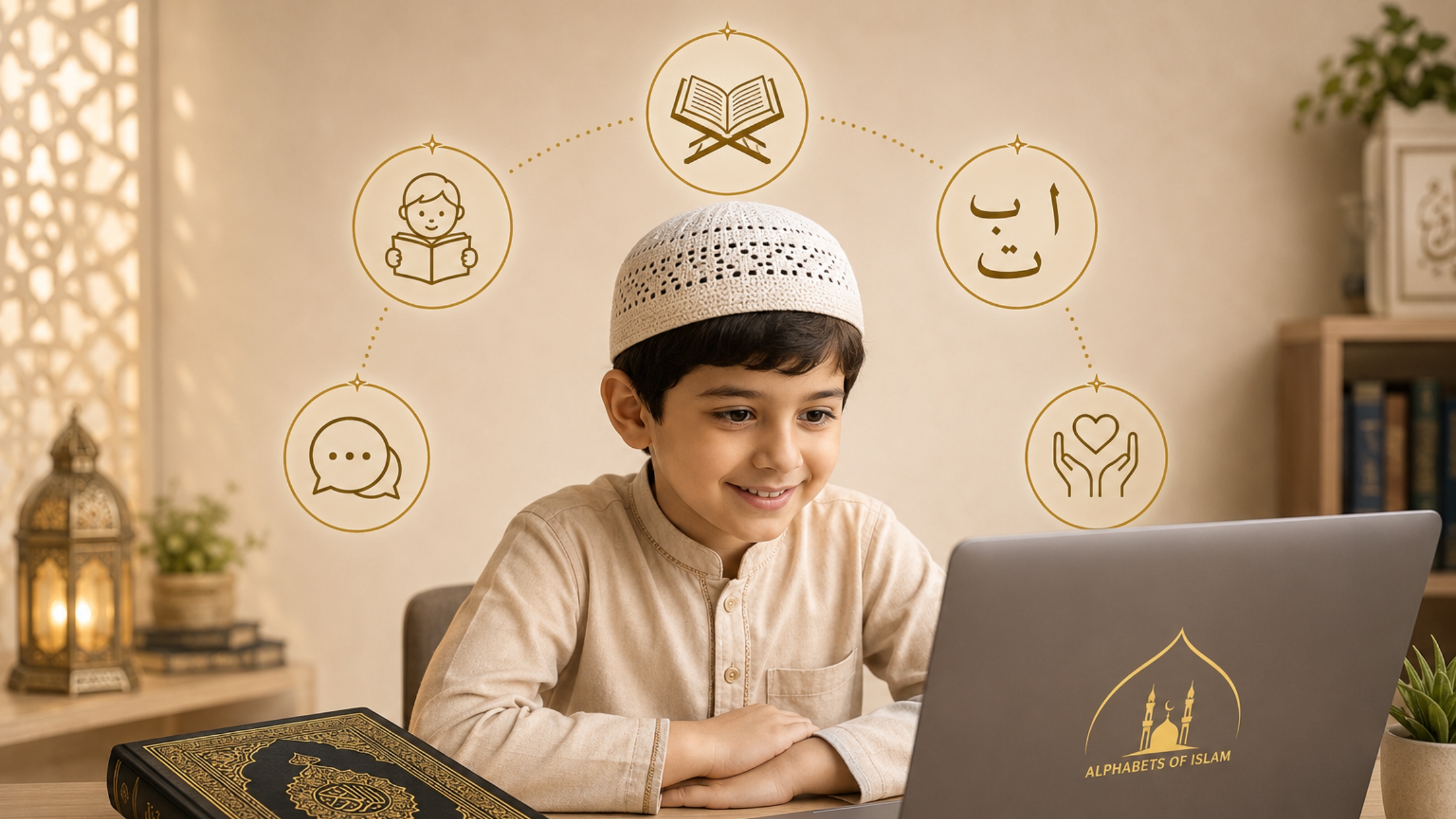
    Smiling child learning Quran online at desk with laptop showing Alphabets of Islam logo, Arabic letters and Islamic education icons above

    “Is my child too young to start Quran classes?”

    It is one of the most common questions parents ask. Many worry about starting too early, while others fear they may be waiting too long. The truth is that there is no perfect age that suits every child. Children develop at different speeds, and readiness is often a better guide than age alone.

    At Alphabets of Islam, we have worked with children from a wide range of ages, personalities, and learning backgrounds. Over time, we have noticed several common signs that often indicate when a child is ready to begin learning the Quran and benefit from structured lessons.

    If you are wondering whether now is the right time, these five signs can help you decide.


    Sign 1 — They Can Sit and Focus for 15–20 Minutes

    Quran classes require a child to listen, repeat, interact with a teacher, and stay engaged throughout the lesson. If your child can sit through a story, a simple activity, or a short educational programme without constantly losing focus, they likely have the attention span needed to begin.

    Most children develop this ability between the ages of 4 and 6, although some are ready earlier.

    The goal is not perfect stillness. Young children are naturally active. What matters is whether they can stay engaged in an activity long enough to learn and respond.

    Children who begin lessons before they can focus for even short periods often become frustrated and lose confidence. Readiness is less about age and more about the ability to participate consistently.

    Practical test: Read a picture book with your child for 15 minutes. If they remain interested, ask questions, and follow along, they may be ready for Quran lessons.

    Keep it light. The first sign of readiness is not about perfection — it is about presence. A child who can stay with you for 15 minutes is already capable of beginning.


    Sign 2 — They Show Curiosity About the Quran or Prayer

    Children are naturally curious about what they see at home. If they watch family members pray, listen to Quran recitation, or attend the masjid, they often begin asking questions.

    They may ask:

    • What do these words mean?
    • Why do we pray?
    • Can I read the Quran too?
    • How do I learn Arabic letters?

    This curiosity is one of the strongest signs of readiness. A child who wants to learn usually progresses faster and enjoys the journey more than a child who feels forced into it.

    If your child has not yet shown this interest, do not worry. Curiosity can be nurtured naturally by playing Quran recitation at home, including children in dua, reading Islamic stories together, and talking positively about learning the Quran. Interest often grows through exposure and encouragement.

    Curiosity is a gift — nurture it. A child who asks “Can I read the Quran too?” is already halfway there. Your role is simply to open the door at the right moment.


    Sign 3 — They Can Recognise Letters in Their Native Language

    A child who has started recognising letters in English, Arabic, German, or another language has already developed an important learning skill. They understand that letters represent sounds and that those sounds form words. This foundation transfers directly to learning the Arabic alphabet.

    Your child does not need to be fluent in reading before starting Quran classes. However, familiarity with letters and sounds can make the learning process smoother and more enjoyable. Many children who are beginning to read in one language adapt quickly when learning Arabic letters.

    Languages share a foundation. A child learning to read English is already building the mental pathways that make Arabic letter recognition far easier than most parents expect.


    Sign 4 — They Can Communicate Clearly With an Adult

    Whether lessons are online or in person, children need to interact with their teacher. This includes following instructions, answering simple questions, asking for help when needed, and responding during activities and exercises.

    Children who can hold a simple conversation and understand basic directions are usually ready for the teacher-student relationship that Quran learning involves.

    A note about shy children: Shyness is not a barrier to success. Many children start quietly and become much more confident after building trust with a patient and supportive teacher.

    On shy children: Some of our most dedicated students began as the quietest in the room. Trust and routine work quietly — within a few sessions, most children open up in ways that surprise their parents.


    Sign 5 — You as a Parent Are Ready to Support Them

    This may be the most important sign of all. A child’s experience of Quran learning is strongly influenced by what happens outside the lesson. Children notice how parents speak about learning, how consistent routines are maintained, and whether progress is celebrated.

    Parental support does not require fluency in Arabic or advanced Islamic knowledge. It simply means encouraging attendance, maintaining a consistent schedule, asking about lessons, celebrating progress, and creating a positive attitude toward learning.

    When Quran learning is treated as something meaningful at home, children are far more likely to remain motivated and engaged.

    The home sets the tone. A teacher can only do so much in 30 minutes. What surrounds those 30 minutes — the attitude at home, the small daily reminders — is what turns a lesson into a habit.


    What Age Is Best to Start Quran Classes?

    We welcome students from age four and above, as well as adult learners who are beginning later in life. Among children, the most common starting age is between five and seven years old. However, readiness matters far more than a specific birthday. Once your child is reading comfortably, the natural next step is learning Tajweed.

    Rather than focusing on age alone, look at the five signs discussed above. They often provide a much more accurate picture of whether a child is prepared to start.


    Common Concerns Parents Have Before Starting

    Many parents hesitate because they worry about challenges their child may face. Here are some of the most common concerns:

    “My child is very shy.”

    Shy children often do extremely well once they become comfortable with their teacher. A calm and supportive learning environment makes a significant difference.

    “My child struggles to focus.”

    Short, engaging lessons are often enough to gradually improve attention and build learning habits over time.

    “My child does not know Arabic.”

    This is completely normal. Many children begin Quran classes without any prior Arabic knowledge and learn step by step. Our Arabic Foundations programme is designed for exactly this starting point.

    “Have we started too late?”

    Children, teenagers, and adults can all learn the Quran successfully. Progress depends far more on consistency than on starting age.


    How to Make the First Quran Lesson a Positive Experience

    The first lesson often shapes a child’s attitude toward Quran learning. To make it enjoyable: talk about the lesson positively, present it as an exciting opportunity rather than a test, choose a time when your child is rested and comfortable, allow them to ask questions freely, celebrate small achievements after the lesson, and be patient during the first few sessions.

    The goal of the early lessons is not rapid progress. It is to build confidence, trust, and enthusiasm for learning.


    Frequently Asked Questions

    Can a 4-year-old start Quran classes?

    Yes. Many children begin learning Arabic letters and short surahs at age four if they can focus for short periods and engage with a teacher.

    What is the best age to start Quran lessons?

    Most children begin successfully between ages five and seven, but readiness is more important than age.

    How long should a beginner’s Quran lesson be?

    For most young learners, 20–30 minutes is enough to maintain focus and enjoyment.

    Does my child need to know Arabic before starting?

    No. Many children learn Arabic letters and Quran reading skills from the very beginning with the guidance of a teacher.


    Not sure whether your child is ready yet? Send us a message and we will happily advise you, recommend the most suitable starting point, and help you find the right teacher for your family.

    WhatsApp Us Enroll Now